I have directed campaigns and activations for American Express, TAG Heuer, Michael Kors, Sephora, and No Name, and I have watched plenty of brand campaigns come back fine. The lighting is clean, the framing is competent, the deliverables land on time, and three months later nobody remembers a single image. Nothing failed, exactly. The work just never did anything.
The reality is that what decides whether images still earn their place a season later is rarely the camera and rarely the budget. It is a handful of decisions made before and during the shoot, and honestly most of them cost nothing.
The brief is almost never enough
A brief tells you what to shoot. It very rarely tells you how to make the images matter, and those are not the same document.
I was hired through an agency once to cover a sampling activation for Canada's leading grocery store chain in Montreal's Plateau. The mood board referenced editorial campaigns, the kind of $40,000 production that comes with cast models, art directed locations, styled wardrobe, and golden hour. The actual brief was three hours on a street corner with branded newsboxes and brand ambassadors in yellow vests, and the cast was whoever happened to walk past.
That gap between the reference and the reality is where a lot of activations quietly fall apart. The images come back looking like documentation because nobody closed the gap on the day, and by then there is nothing an edit can do about it.
So I cast someone I knew to direct: the right look, and able to hold a pose in the cold for three hours. While the brand ambassadors handled the sampling, I shot editorial frames with her. Tabloid in hand, seated on the newsbox, apple held up like a jewel, the off camera gaze that reads as editorial rather than event coverage.
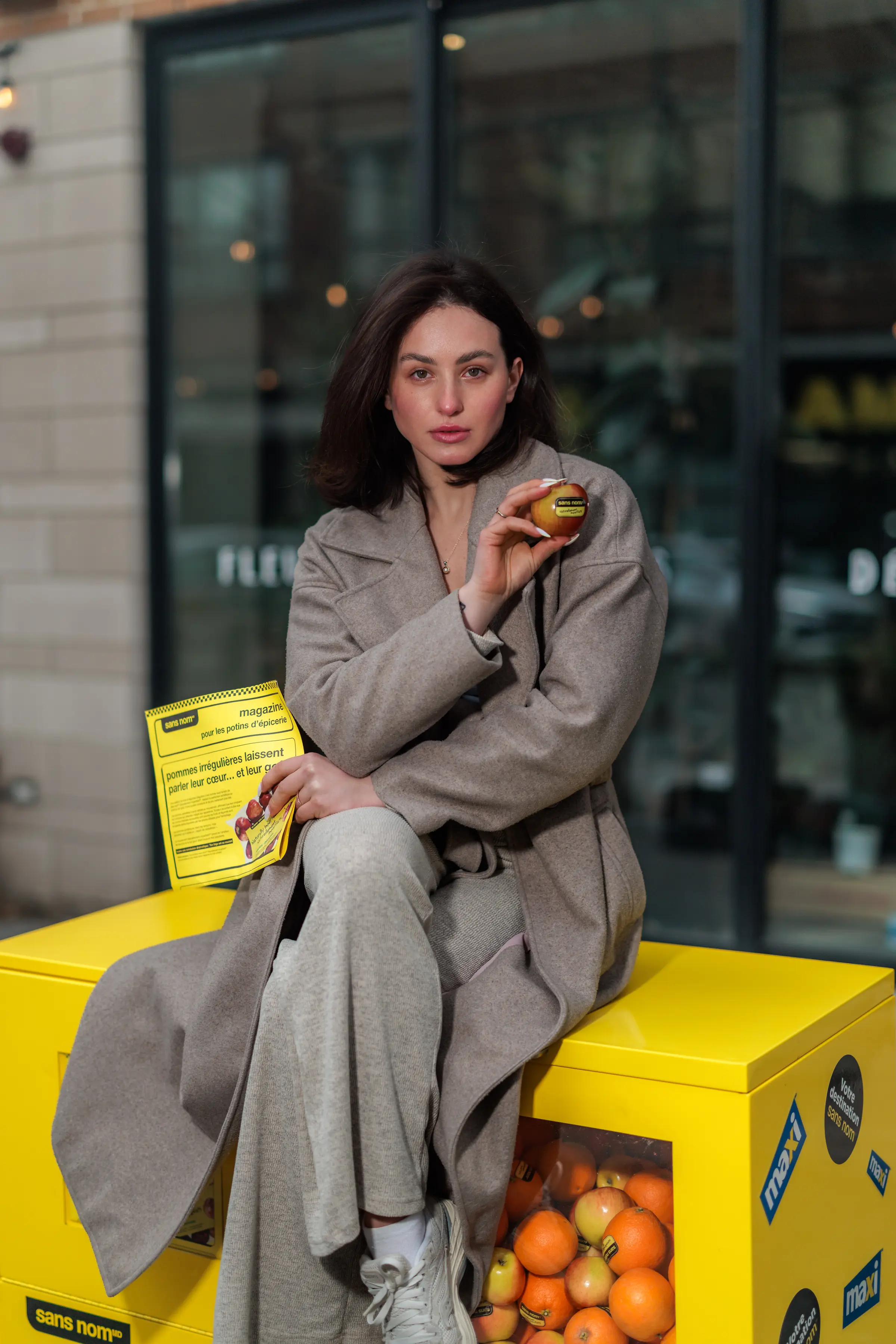
The result was two distinct galleries: one of activation documentation, the proof the event happened, and one of editorial hero images, the content the brand actually wanted for social and press. The agency got both. The brief had only asked for the first, and the second is the reason any of it was worth looking at six months later.
That pattern runs through all of my campaign photography and creative direction work. The brief is the starting point, and the direction is what turns it into something the brand keeps reaching for.
One good frame beats fifty average ones
Volume is the enemy of impact here. A gallery of 300 images where every shot looks the same teaches a client nothing about their own brand, and a set of 30 where each frame is doing a specific job gives a marketing team content for months.
The trap on a brand shoot is staying in one gear. Wide shot of the setup, wide shot of the crowd, wide shot of the speaker, and at the end of it the room is thoroughly documented and the story is nowhere.
So I shoot in three layers, the same way I do on a corporate day. Wide establishes the scene, medium carries the interaction and the energy, and tight is where the detail and the emotion live: a hand pulling a product from a display, a reaction with the background blurred out so the expression is isolated, the branded signage caught before anyone arrives. Those tight frames are the ones that end up on social and in the recap decks, and almost none of the wide ones do.
On a shoot for Sephora's Global Huddle at the Four Seasons, the images the team kept returning to were all tighter frames. A speaker caught in a moment of conviction. Two executives in conversation with the branded backdrop soft behind them. The wide room shots were necessary for documentation. The tight shots were the ones that carried the brand.
The editorial pass most activations skip
Brand activations have a documentation problem. The standard deliverable is a recap gallery that proves the event happened, with the logos visible, the foot traffic captured, and the brand ambassadors smiling. All of that is necessary and none of it compounds.
The editorial pass is what turns activation coverage into campaign content, and the gap is the one between a photo of someone receiving a sample and a portrait of someone engaged with the brand. The first is evidence. The second is the reason anyone looks twice.
So on activations and event coverage I build both into the same shoot: documentation for the recap, editorial for the portfolio and the brand's long term use. The recap is what closes out the report internally, and the editorial is what wins the next brief, which is why I have never understood treating them as an either/or.
None of that happens on the day though. It takes scouting the location ahead, working out which backgrounds have texture and which are flat, deciding flash or natural light before the first frame, and bringing a lens pairing that lets you move between environmental coverage and tight portraits without missing the moment. Those decisions all get made before the event starts, and they shape everything that comes after it.
Real people over stock perfection
The images that drive the highest engagement are almost never the most polished ones. They are the most real ones, which is an annoying thing to be true.
Caryn Neary, who runs TAG Heuer events, put it simply: "Our best campaigns are those where the visuals showcased our people and our clients, not just our services."
That tracks with everything I have seen across hospitality, luxury, and corporate work. A genuine moment between two people lands harder than a perfectly lit product shot on white, every time. Real expressions, real settings, real light where I can get it, because audiences read authenticity faster than they read production value and they are not wrong to.
Real does not mean sloppy though, it means directed. Two things make it work: a, I give prompts instead of poses, so people interact instead of arranging themselves, and b, I keep the energy in the room low enough that the camera catches something honest. Then I edit for cohesion so the gallery reads as a set rather than a pile of moments.
Editing discipline is the whole difference between real and raw. Colour temperature matched across the gallery, skin tones consistent, distractions taken out. That cohesion is what separates images a brand publishes proudly from images that quietly embarrass everyone six months later.
Why unedited files do not exist
The request I push back on most is for unedited photos. The event ends, and within the hour someone asks for the raw files so they can post immediately.
I understand the urgency and social rewards speed, so the instinct is right. Unedited photos are just not finished work: the white balance is inconsistent, the exposure moves frame to frame, the backgrounds distract, and nothing in the set feels like it belongs with anything else.
When a client needs content the same day, I build that into the scope before the shoot, and it changes the production plan, the editing workflow, and the price. What it never changes is the standard. No unedited files leave my drive.
The brief leaves better than it arrived
Every brand campaign I direct starts with the same question: what should someone feel when they see these images. The answer shapes the scouting, the lighting, the casting, the editing, and the delivery, in that order.
If you are planning a campaign, an activation, or a brand shoot that needs to do more than document, tell me about it. The work starts well before the camera does.