I have shot corporate events for Google, Sephora, Wealthsimple, and the Montreal Canadiens, and headshots for LinkedIn and Kenvue. I have also produced my share of corporate photography that looks like everyone else's. Wide shot of a speaker at a podium, group photo in the lobby, a few candids that feel more like a passenger in the room. The images exist and they do not do anything, and everyone involved can feel that without quite being able to name it.
The reality is that what separates a gallery a team pulls from all year from one nobody opens twice is not the equipment, and it is not a lighting trick. It is a handful of decisions, most of them made before anyone turns a camera on, and I want to walk through the ones that actually move it.
Details tell the story wide shots cannot
The thing that quietly ruins most corporate galleries is too many wide shots. A room full of people at tables tells you almost nothing about what happened there or why it mattered to anyone in it.
The images that get used are the ones with texture: a tight shot of hands writing notes, a reaction with the background blurred so the expression is isolated, the branded signage outside the venue before anyone walks in, a pen on a notepad next to a lukewarm coffee. Those are what end up on social, in the recap decks, and in the internal newsletters.
So I shoot in three layers, and I say it out loud on set now because naming it makes the whole day easier to run. Wide establishes the scene, medium carries the interaction and the energy, and close is where the emotion and the detail live. A gallery that never leaves layer one documents a room and misses the story inside it, which is how you end up with 200 frames and nothing to post.
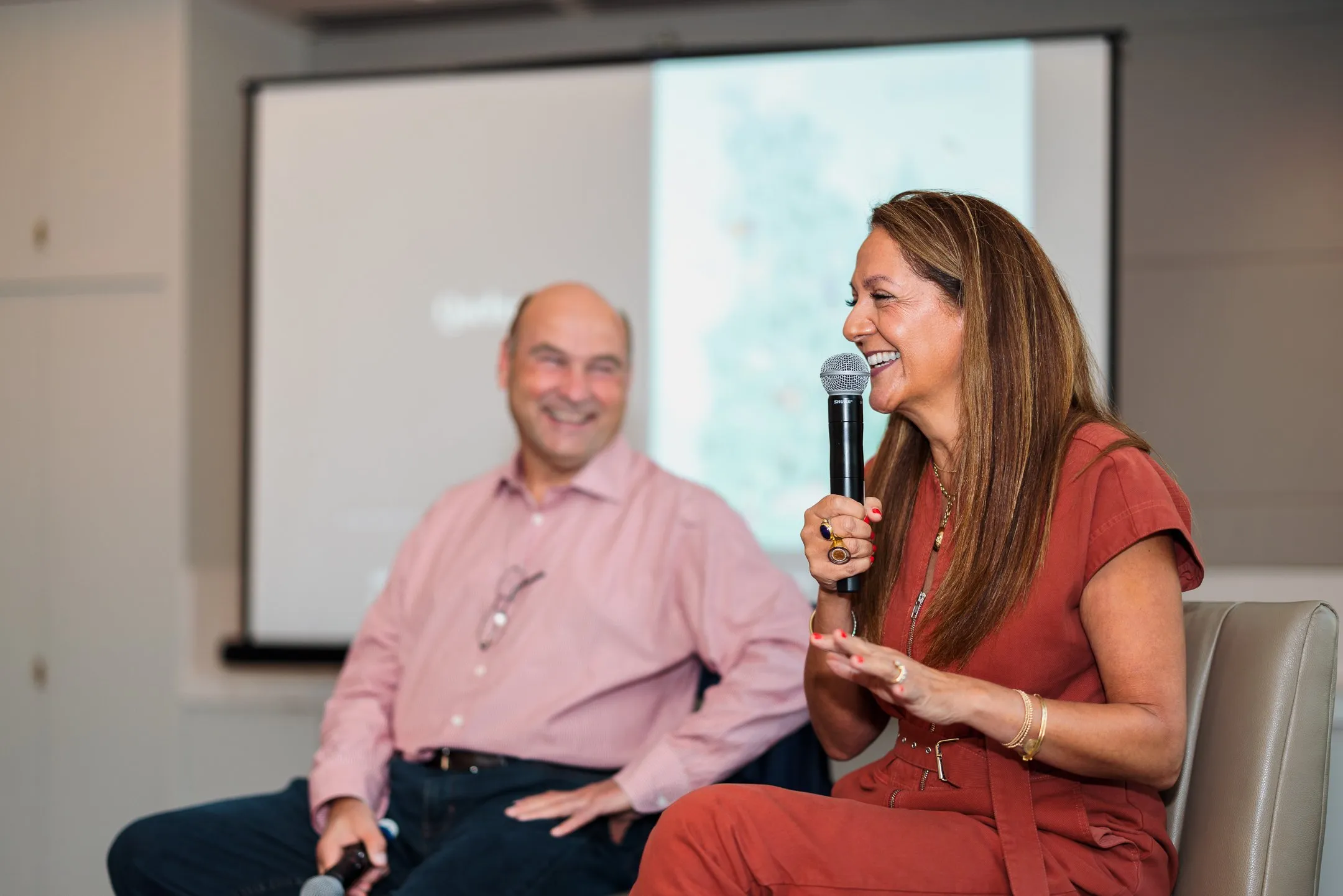
A corporate shoot for Sephora's Global Huddle at the Four Seasons needed coverage across keynotes, breakout sessions, and evening receptions. The wide shots were necessary and nobody has ever gone back to them. What the team kept returning to were the tight frames: a speaker caught mid sentence with real conviction on her face, two executives in conversation with the branded backdrop soft behind them. That is where the value sat, and it sat there in about six frames out of several hundred.
The first 30 minutes decide everything
I arrive early, always, and the first thing I do is walk the room. Two things are happening in that walk and they matter about equally: a, I am reading the light, and b, I am reading the people, and I have never been able to do one without the other.
The light half is the obvious half. Can I use flash, or does it pull focus off a speaker on stage? Is there real window light here, or am I on overhead fixtures all day? Where does the gear bag go so it stays reachable and invisible at the same time? All of that gets answered in the first thirty minutes, and it shapes every frame after.
It matters because corporate rooms do not hold still. Things change between rehearsal and the live event, lighting rigs get adjusted, furniture moves, and if I have not walked the space myself then I spend the day reacting instead of directing. Reacting gets you acceptable images, which is a real outcome and not the one anybody is paying for.
The people half is the same read, honestly. I introduce myself early to the event coordinator, the comms lead, the CEO if they are around, and that is not networking, it is practical. Someone who knows who I am before the camera comes out is looser when I photograph them two hours later. First impressions set the permission level for the whole day, and the permission level decides what I am actually able to shoot.
Stop asking for unedited photos
This is the request I push back on most. The event ends, and inside the hour: can you just send us the raw ones so we can post tonight.
I get the urgency and the urgency is real. Social moves fast and a recap loses most of its impact after 48 hours, so the instinct is right. Unedited photos are just not ready to carry a brand: the white balance wanders, the exposure moves frame to frame, the backgrounds distract, and nothing in the set looks like it belongs with anything else.
Editing is not a cosmetic pass at the end. It is where individual files become a set, where the colour temperature matches across the gallery, the skin tones look natural and consistent, the distractions come out, and the work starts to look like it belongs together. That cohesion is what separates images a brand publishes proudly from images that quietly embarrass everyone six months later.
When a client needs same-day delivery I build it into the scope upfront, and it changes the shoot plan, the editing workflow, and the price. What it does not change is the standard. No unedited files leave my drive, because the images carrying your brand should be ready to carry it.
Headshots need life in the eyes
Executive headshots are the assignment everyone assumes is simple. Stand here, look there, smile, done. Then the file comes back and the person in it is a deer in headlights wearing a good suit.
Most headshots fail the same test, and you can run it on your own team's photos right now: cover the mouth with your hand and look only at the eyes. If the eyes are flat then the portrait is dead, because a smile means nothing without the eyes participating in it.
I learned that during COVID, when everyone was masked and the eyes were the only thing left to read. A real connection showed up in the crinkle of the smile lines. A forced one showed up nowhere at all. The mask made something obvious that had always been true and that I had been getting away with not knowing.
It changed how I direct headshots permanently. Now I spend real time with someone before I shoot anything, and not small talk: I ask what they are working on, what they are proud of, what they are building. When something lights them up I see it in the eyes first, and that is when I shoot.
Some people do not come loose from a conversation, and for them I have one more move. I ask them to close their eyes and take a deep breath, then think of someone or something that makes them genuinely happy. A person they love, a puppy, whatever version of themselves they like the most. I count to three, and on three they open their eyes and look into the lens as if that person were standing right behind it.
It works because a lens is an object and people perform at objects. Replace the object with someone they care about, even an imagined someone, and the impulse to perform falls away.
The technical setup matters too, and none of it is exotic. Darker textured backgrounds rather than flat white, waist up rather than a tight passport crop, soft directional light that shapes the face instead of flattening it. You can do every bit of that correctly and still hand back the good old clean corporate headshot, perfectly exposed and completely empty, because the person behind the expression was never actually in the room. The eyes are the whole portrait.
What a useful corporate gallery actually looks like
A corporate shoot should deliver more than documentation. When the gallery arrives, a marketing team should be able to pull images for every channel. Social posts, website headers, press releases, internal decks, recruitment pages. All from one shoot.
That means variety in framing, subject, and context. How the day felt, what people were thinking, and the life of the room carry as much weight as the documented facts.
When corporate photography and video is directed with this range in mind, a single shoot produces months of usable content. The alternative is a folder of 200 nearly identical wide shots that no one opens again after the first week.
Before you book your next corporate shoot
If there is one thing worth taking from this, it is that the value of corporate photography gets decided before the shutter ever clicks. The scouting, the planning, the direction, the editing standard: all of it is invisible in the final image, and all of it is the reason one gallery gets pulled from for a year while another is forgotten inside a week.
If you are planning a corporate event, a leadership portrait session, or a team shoot, tell me about it. Every one of them starts with the same question, which is what someone should feel when they see the images, and the answer shapes everything that follows.